












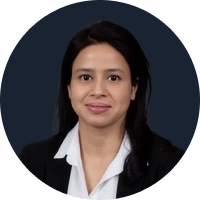









Sebastian Trujillo
Director of Product Marketing, TRC Consultants LC
Sebastian Trujillo examines what AI can and cannot do in upstream reserves work, where it's moving faster than the standards built to govern it. Drawing on direct tool testing and SEC enforcement history, he gives engineers a clear framework to separate real capability from marketing claims. The engineer signs the report, not the AI.

EXPERTISE: Software Commercialization | B2B Marketing | Leveraging Generative AI and LLMs for Search Marketing
AI Can't Sign Your Reserve Report: Defensibility, Accountability, and the Limits of AI in Reserves Work
AI tools are entering upstream reserves workflows faster than the professional standards to govern them. This session provides an honest, evidence-based examination of what AI can and cannot do in reserve estimation, decline curve analysis, and economic evaluation.
The engineer’s name is on the reserve report. The AI’s is not.
Sebastian Will Cover
The accountability chain and where AI fits
Understand the legal and professional structure that breaks when AI enters the reserves workflow
Live evaluation of AI decline curve tools
Real-world demonstration of how current AI tools perform (and fail) on actual decline curve analysis
Five failure modes that disqualify AI output
The specific, reproducible ways AI-generated reserves estimates become professionally indefensible
The reproducibility problem with LLM tools
Why prompt sensitivity, model version drift, and skill-file mutability make AI output non-auditable
Ten questions to ask before trusting AI tools
A practical framework for evaluating whether an AI tool is safe to use in your reserves workflow
Who is this session for?
Qualified Reserves Evaluators, petroleum engineers, geoscientists, A&D professionals, and anyone whose name goes on a reserve estimate.
2026 Session
Qualified Reserves Evaluators, petroleum engineers, geoscientists, A&D professionals, and anyone whose name goes on a reserve estimate.
September 18
11:00 AM – 12:00 PM (CT)
35-45 Minutes
Solo Presentation
Live Streaming
Replay available after event

Sebastian Trujillo
Director of Product Marketing, TRC Consultants LC
Sebastian Trujillo is the Director of Product Marketing at TRC Consultants, where he focuses on how emerging technology, including AI, intersects with professional standards in upstream reserves work. He has conducted direct technical evaluation of AI-powered forecasting and decline curve analysis tools currently in the market, examining where they genuinely add value and where they fall short of professional requirements.
His work draws on structured review of SPE literature, SEC enforcement history, and enterprise AI deployment data, giving him a grounded view of the gap between vendor marketing claims and what these tools can actually deliver in reserve estimation, economic evaluation, and reporting workflows.
Sebastian helps reserves professionals build a practical framework for evaluating AI tools separating genuine capability from hype and understanding where accountability ultimately rests when a reserve report is signed.
Career Timeline
Jun 2022 - Present
Director of Product Marketing
TRC Consultants, LC
Oct 2009 – Present
Founder
Empower Ecommerce LLC
Oct 2020 - Present
Venture Scout
Clearco
Licenses & certifications
Extract, Transform and Load Data in Power BI
Microsoft · Issued Mar 2025
Core Expertise
AI EVALUATION IN RESERVES WORK
Direct technical testing of AI-powered decline curve analysis tools currently in the market.
DEFENSIBILITY & ACCOUNTABILITY
The accountability chain in reserves estimation, and the failure modes that disqualify AI output from SEC filings and audits.
AI VS PROFESSIONAL JUDGMENT
A practical framework for AI assistance versus AI accountability in reserve estimation and economic evaluation.
What the Session Establishes
Seven findings from direct testing, SEC regulation, and SPE literature and where each one leaves the engineer.
THE SIGNATURE IS NOT TRANSFERABLE
Signing a reserve report is a professional, legal, and ethical act tied to one named individual. SEC Regulation S-K requires a specific, qualified person standing behind the evaluation.
PATTERN MATCHING, NOT REASONING
Modern neural networks match patterns across tokens and vectors inside a black box. The path to any answer is difficult to fully grasp or replicate.
THE SYMBOL GROUNDING PROBLEM
An LLM relates symbols to other symbols by statistical association. Nothing in that process connects to rock properties, fluid dynamics, or pressure.
REPRODUCIBILITY FAILED UNDER TEST
Testing on the open-source CrudeCode tool returned different results from identical inputs. Non-deterministic setup, prompt sensitivity, and vendor-side updates all move the output the opposite of what a defensible audit requires.
HIDDEN DEFAULTS YOU NEVER SET
Price decks, OPEX, and discount rates hard-coded beyond the engineer's reach, quietly shaping the economics of every run.
WHERE AI GENUINELY WORKS
Purpose-built models like Chevron's Apex and Apollo, real-time geosteering and drilling optimization, artificial lift failure prediction, and parsing lease operating statements out of large repositories.
ASSISTANCE, NOT ACCOUNTABILITY
Bulk data edits, QC passes, and retrieval are real uses. None of them replace the workflow — a machine cannot hold a license, carry insurance, or answer in a court of law.
Research Sources: AI in Reserves Work
Questions This Session Answers
- What is an AI model actually doing when it produces a forecast, and does that meet an engineering standard?
- When a tool claims to reason or think, does that change what the output is worth?
- Why can the same well data produce a different answer on the next run?
- Can an AI tool make the judgment calls a defensible forecast requires, like anchor point and boundary dominated flow?
- Can it tell you when its own fit is wrong?
- Can it produce an estimate that survives a third-party audit?
- When the number is wrong, who is accountable?
- Where does AI genuinely help in reserves work, and where does it not?
- Will better models fix these problems, or are they structural?
- What should you ask any vendor before trusting an AI reserves tool?